 |
| The first three Ultima games, collectively known as the 'Age of Darkness' were some of the best gaming experiences around in the early '80s. |
Most long-time RPG players are likely to know that series like Dragon Quest and Final Fantasy and the majority of the older great RPG games are Japanese in origin. In fact it has only been relatively recently (ie the last decade or so) that great (and/or great selling) RPG games have again started to emerge from North America and Europe - but before the Video Gaming industry shifted to a decidedly Japanese focus, Ultima was a huge name in gaming.
The series would rise to popularity on early PCs (Apple II, Commodore 64, early IBM compatibles, etc.) and eventually spawn one of the earliest and longest running MMORPGs (Ultima Online, started in 1997 - still going!). But, it was in the early '80s that Lord British himself, Richard Garriott made Ultima: The First Age of Darkness (later known as Ultima I) and founded the franchise.
 |
| The Original Ultima was released on the Apple II computer in 1981 |
Ultima presented a fantastic world to the player likely unlike anything he/she had ever experienced before. It established a trope that would be in most RPGs moving forward, a topdown overworld with various dungeons. The dungeons in Ultima are displayed in first person, one-point perspective (much like the later Shin Megami Tensei series). The game starts with character creation not unlike table-top RPGs (like Dungeon's and Dragons) in which the player chooses a race (and class) and has a number of attribute points to customize their character with. Ultima was also unique in that it allowed the player to pick a gender (although it had little to no effect on the gameplay). The character had Hit Points (abbreviated HP, this would become standard in even modern RPGs) Food, Experience Points (or EXP) and Gold. Ultima had fairly rudimentary magic and combat systems but the combination of all of these things together involved in an overall story made the game incredibly deep and engaging for the time.
 |
| A screenshot of the overworld of Ultima I |
 |
| A screenshot of Ultima's space sequence, the enemy fighter looks similar to a TIE fighter from Star Wars |
 |
| Ultima II was originally released in mid 1982 |
Ultima II built upon the original, it was larger with more places to explore (even several planets, dungeons and towers that could be fully explored but were not required to complete the game). The game had the player traveling through several different time periods of Earth and out into the solar system. It is interesting to note that Ultima II took place on Earth when Ultima I (and all other games in the series) took place in the land of Sosaria/Britannia - this was later retconned as the lore of the Ultima universe grew.
 |
| Ultima II had a very similar visual style to Ultima but had a few enhancements. |
 |
| Inside the dungeons in Ultima II there were actual pixelized monsters instead of just stick figures |

Ultima III: Exodus was released for the Apple II in 1983 and further catapulted the franchise to popularity. For the time the game had amazing graphics, it was the first computer RPG to display animated characters. It introduced a character party, in which the player could control the actions and destinies of up to 4 characters (a feature influenced from the game Wizardry that would go on to be in most later major RPGs). The battle mechanics of the game were also upgraded to include rudimentary tactics and understanding of the weapon and magic system could now really effect the outcome of a battle.
Ultima III: Exodus was more widely ported than the first two games, specifically Exodus was the first to receive a home console port in the form of the upgraded NES version released in 1988. All three games of the original series were redone and released for DOS in 1986 shortly after the release of Ultima IV - this is the version that most played and is still most widely available today, besides graphical updates the games remained largely unchanged.
 |
| Ultima III's overworld continued to receive graphical upgrades along with the Character Party system. |
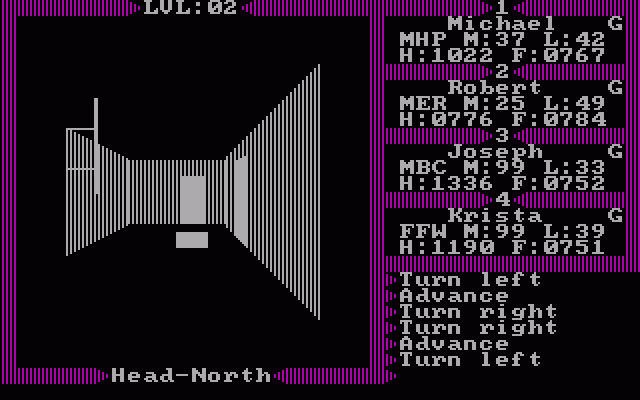 |
| Ultima III's dungeons were no longer wire-frame but 3D (albeit rudimentary) |
Further Reading:
Wikipedia:
http://en.wikipedia.org/wiki/Ultima_(series)
http://en.wikipedia.org/wiki/Ultima_I:_The_First_Age_of_Darkness
http://en.wikipedia.org/wiki/Ultima_II:_The_Revenge_of_the_Enchantress
http://en.wikipedia.org/wiki/Ultima_III:_Exodus
GoG.com
http://www.gog.com/game/ultima_1_2_3


